 Clothing · 2026
Goose & Gander opened five stores on Fulfil and shipped a peak-sized August from one warehouse floor.
The UK clothing brand has sold on Shopify since 2013. On Brightpearl and PeopleVox, adding a festival or a shop as a stock location meant a paid change to the API between them. Goose & Gander moved to Fulfil, went live overnight, and now replenishes five stores every day.

The story in short
- Sells
- Unisex clothing, designed, decorated and shipped from its own HQ in the South West of England
- Channels
- Shopify since 2013, five stores, and festivals and events
- Before Fulfil
- Brightpearl for orders, PeopleVox for the warehouse, and a paid third-party API between them
- Who speaks
- Olly White, Director and Co-Founder
01
Goose & Gander has sold on Shopify since 2013, and in 2026 it has five stores.
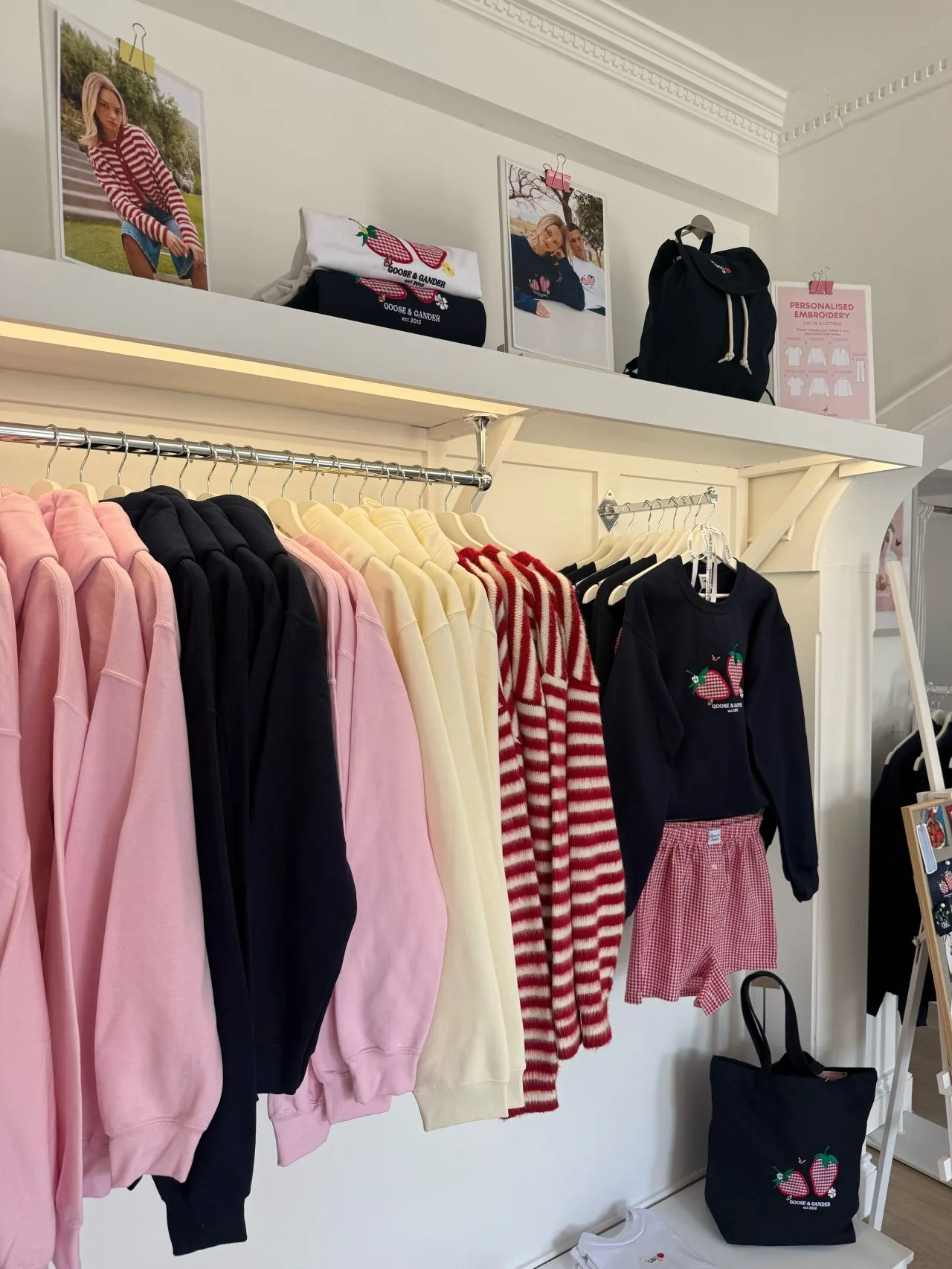
Goose & Gander is a UK clothing brand from the South West of England. It started in 2013 on Shopify and has sold there ever since. It also sells at festivals and events, and in 2026 it has five stores of its own.
 Olly WhiteDirector and Co-Founder, Goose & Gander
“We started in 2013. We've always been on Shopify. This year in 2026, we've accumulated five stores as well.”
Goose & Gander's first stack was Shopify into Brightpearl. A few years later it added PeopleVox as its warehouse management system, and paid a third party to build an API between the two.
02
On Brightpearl, each new location or feature was a paid project on the API.
Goose & Gander takes stock to festivals. The systems could not treat a festival as a location, so the team sold without seeing its stock and moved the transfers by hand.
 Olly WhiteDirector and Co-Founder, Goose & Gander
“we were having to go to an event and sell blind, where we kind of knew what stock we were going with.”
When the brand wanted five festivals at once, each new location was a change to the API. The first reason it needed the API at all was an order editing app: a product a customer added after checkout had to reach the warehouse system.
Olly WhiteDirector and Co-Founder, Goose & Gander“the system restrictions started to dictate how we operate.”
Each further change was another project, at about 5,000 pounds a change by Olly White's estimate.
03
Adding a store to the system took longer than opening the store.
When Goose & Gander planned its first stores, it had to find a site, sign a lease, stock the shop and hire a team. Setting the shop up as a location in Brightpearl took longer than all of that.
Olly WhiteDirector and Co-Founder, Goose & Gander“You're telling me that adding a location onto my system so we can sell stock from that location takes longer than opening a shop”
Olly White had mastered Brightpearl. Every small change he wanted was a change request.
04
A LinkedIn photo of Fulfil's team on another brand's packing floor brought Goose & Gander to Fulfil.
Olly White had known of Fulfil for years. Then he saw a brand's LinkedIn post with Fulfil's people at its packing station during a go-live. When Goose & Gander went live on its earlier systems, nobody came to help.
Olly WhiteDirector and Co-Founder, Goose & Gander“I thought, what? Those guys are on the ground with them.”
He compared the two systems the way a Shopify brand compares Shopify with Magento. Order routing and the rest were at hand in Fulfil.
Olly WhiteDirector and Co-Founder, Goose & Gander“Like my system was almost like a Magento of e-commerce and you guys were the Shopify.”
Fulfil is in the USA, and that worried a UK brand. Olly White weighed the cost of a visit against the cost of a failed go-live. Fulfil's migration team came to Goose & Gander twice.
05
Goose & Gander went live late at night and was picking and shipping by morning.
Goose & Gander chose to go live late at night, so anything that broke would break overnight. When Fulfil's team arrived the next morning, the warehouse was already shipping.
Olly WhiteDirector and Co-Founder, Goose & Gander“The guys actually said our warehouse launch was the smoothest they've ever seen, which was cool to hear.”
Olly WhiteDirector and Co-Founder, Goose & Gander“It was almost anticlimactic, really. It was pretty calm.”
On a warehouse visit, Fulfil's team tested the internet in the shipping room to find out why labels printed slowly. The cause was the computers, and Goose & Gander now has a list of equipment to buy.
06
Goose & Gander replenishes five stores every day and shipped a peak-sized August from one floor.
Before Fulfil, stock came into the warehouse and went out to customers. Now five stores get stock every day. Goose & Gander calls these internal shipments, planned from each shop's stock and demand, the warehouse stock and what is on the way from suppliers.
Olly WhiteDirector and Co-Founder, Goose & Gander“We went from receiving delivery to our warehouse and then any outbound is going to a customer to then having five stores, which have daily replenishment.”
The team built a heat map of its warehouse with AI, linked to Fulfil: which SKUs sit in which bins, where the best sellers are, and which SKUs to put together in one bin.
Goose & Gander's peak is usually November and December, with stock on two floors. In August it took a similar amount in sales from stock on one floor, across six channels.
Olly WhiteDirector and Co-Founder, Goose & Gander“We achieved similar revenues in August through stock on one floor and through five, six different sales channels.”
Olly White expects to use more of Fulfil than the brand does today.
07
The film, word for word.
Read the transcript of the Goose & Gander film
It was almost anticlimactic, really. It was pretty calm. It wasn't like this big, crazy, oh my God, gone live. It was very much like matter of fact, controlled. That's kind of what you want system launch to be like. We started in 2013. We've always been on Shopify. This year in 2026, we've accumulated five stores as well. Our first tech stack in this space was Shopify into Brightpearl. And then we bolted on a warehouse management system too. After a couple of years, after a few years, when we changed the way we process orders. And then we wanted to do some more advanced, well, I would say fairly basic actually. We wanted to sort of have our systems mirror where the brand was going and what we needed to do from a stock and operations point of view. And then we had to kind of get this sort of API third party to customize how our order management system, Brightpearl, spoke to our warehouse management system, PeopleVox. And yeah, that's sort of when we first spoke to Fulfil.
Because as you guys know, fast paced, moving business brand, like, you know, you need something that can like move with the times. We kept on wanting to push the boundaries on what we were doing. And at the pace we were wanting to do it, just those systems tech stack wasn't for us anymore. We would go and do an event somewhere like a festival. And, you know, we kind of really wanted our system to recognize that we're taking this product to an event. And it differentiates between the warehouse and the event. And it maintains the visibility on all the costs and all the products there. And to seamlessly, from a [unclear] point of view, transfer that stock to that event location and then sell seamlessly at that event location. And then receive the stock back into the original location. Yeah, like, as basic as that, you know, so, you know, we were having to go to an event and sell blind, where we kind of knew what stock we were going with. But like, point of [unclear], and like, we just lose visibility on what we were selling. [unclear]. Or it was taking a huge amount of time from an administration point of view to manage those stock transfers. And we got to the point where we wanted to do like five festivals at a time. And the change controls we were having to do with our API and systems, just to add those locations on, you know, it was just these projects to do such a simple change like that. And what it ends up doing is the system restrictions started to dictate how we operate. And yeah, it was quite restricting in that way. I didn't like that. I didn't like that.
And I felt what I was asking for, e.g., like, give you another example. You've got an order editing app, which is really great, right? After the customers place their order online, they can change their address. They can add products on. I think that's really cool. Obviously, that needs to be updated in your warehouse management system. So something like that, not only would I be like, yeah, thumbs up on that app, but then I'd also have to like, you know, that was actually the first reason why we needed to use this API third party [unclear]. To just enable that functionality of adding a product to a customer order. Yeah. Yeah. I had to go through all these projects and spend thousands of pounds on it just for that bit of functionality. And then within that functionality, it would probably be a similar cost to add on like an additional five bits of functionality that you might need in the future. So then you're kind of there going, well, like, should we just get the guys managing the API to just do that one bit of functionality? Or should we get them to do like five at a time? Because there's an, but then like, you know, we couldn't, you know, you're running out of time. You need it done. So then you get one done. And then if you want another four, you're going to have to spend an extra 5,000 pounds per change you do because the whole project again. So like financially, like it just became even the time, the length of time to, to, to implement like that just didn't, it just didn't fit. Didn't make sense. It didn't feel, it didn't feel right. Like I go by my gut. It just stopped feeling right for the brand we were.
When we started to consider launching and opening stores, you know, if I want to open a store, that whole journey of getting the doors open from finding a location, getting a lease signed, getting [unclear] there, building a team, blah, blah, blah. You're telling me that adding a location onto my system so we can sell stock from that location takes longer than opening a shop and, and, and requires as much intervention as opening the store does from our point of view. Like that, that, that, that's not right. Doesn't, didn't seem right.
Fulfil [unclear] on my radar for a number of years. So I was familiar with the company. I actually just went on LinkedIn randomly. And I saw a picture of a brand that they posted a picture of a couple of people at a packing station and they had tagged Fulfil in the post and said, great to have Fulfil down in the warehouse while we go live or something. I looked at that and I thought, what? Those guys are on the ground with them. That's, that's, you know, I like that. That's, um, something I haven't experienced. Like when we went live with our systems, like no one came down to help us. Like, and I thought, wow, that's interesting. So then I sort of clicked through on Fulfil and I was like, oh no, no, like I've been keeping an eye on this system. Um, and then I looked into the functionality. Like my system was almost like a Magento of e-commerce and you guys were the Shopify. It was like, it just fitted better with what we were doing. Like the ability to route orders or, you know, you kind of had everything at your fingertips. It was like an [unclear] first brand, like built fast moving company on the forefront of like developing their product. You know, and that's kind of like resonated with what we were trying to do. Like we were fast moving, lots of good changes. I feel like I've mastered the old system. There's nothing else for me to do that. And any little bit of change I want to do, like it was complete and utter change request. Whereas Fulfil, like we're probably barely touching the surface of what Fulfil could offer us.
UK English brand. Um, one of the hesitations was, well, you guys are over in, in USA. And when you change your ERP system, it's not all about like, you know, cost isn't just the most important thing. Because if, if it goes wrong, like it's far more expensive than, you know, paying for travel or accommodation for someone to come down. So like with the migration team coming down was like, it was great to have that option. Like it wasn't even an option previously to even do that. Um, so obviously when they came down, like you feel a lot more comfortable because they've come and seen the place. Um, they understand the business far more. And also you've met the person that you're kind of working with remotely, essentially. So when you meet them, like, yeah, you just build that real relationship with them when they're on the ground. I think we had the Fulfil guys down twice.
The guys actually said our warehouse launch was the smoothest they've ever seen, which was cool to hear. By the time they got in on the next morning, we went live like that night. We're like, if we want anything to break, it's going to be like, went live late at night. Then in the morning, by the time they got in, like our guys were already picking and shipping orders and stuff. So they were super happy, super happy with the launch as well. And then subsequently as well, like we've met, you know, a couple of, a few, a few times now with like the senior team from, from Fulfil as well. Like, you know, inviting us to London and they've come down to our shop in HQ as well. And like, I've been using those opportunities to like, you know, learn about business and stuff as well. Right. Like I'm not just asking them about the system and stuff, although I am. So I'm super interested in it all. I'm actually using, we were using those opportunities to talk about like their experience building a company, what it's like, advice on managing people and everything like that. So I'm picking their brains on all sorts of stuff. So even to be in the same room as, as some of the senior leaders in Fulfil and the founder as well, like was really cool for us.
We went from receiving delivery to our warehouse and then any outbound is going to a customer to then having five stores, which have daily replenishment. We call them internal shipments. So, you know, understanding what each of those stores require based on what they have at their, their, their shop store, what demand they've received, what product is available at our warehouse and what product is coming on the way from our suppliers. Like that, that whole piece there just didn't exist really. So, you know, we kind of like everything we needed existed in Fulfil.
We can heat map our warehouse to understand what SKUs are in what bins. And then we can color code where those products are sitting. How, you know, have we got SKUs that are spread out over the warehouse? Where's the best selling SKUs? Where are the SKUs that we need to condense into the same bin? And where should we move that in the warehouse? Like, like we have that, it's not a, it's not a spreadsheet. Like we have that interface built visually through AI that's linked to Fulfil exactly how we want to see it. Like, like anything we want to see from a data point of view, we can build it into an interface. So like visibility on our warehouse, Fulfil has unlocked that for us, which now means that we can be smarter with our space.
We had a really good August and the amount of sales we achieved are similar to like, you know, a November or December, which is our normal peak. And we'd normally have stock across both floors. We achieved similar revenues in August through stock on one floor and through five, six different sales channels. The complexity to what we've just done with Fulfil versus strictly online orders from two floors is like through the roof. Right. And it actually felt smoother, you know, because those sales are happening across six channels and we have to get stocked at the right place at the right time. And we're working off one warehouse floor. So like, yeah, it's been pretty efficient. And then obviously the pick pack ship, like, you know, yeah, it's, it's much more organized now because, you know, the way that Fulfil [unclear] understanding, like what's the best way to pick and to ship.
And even coming into our warehouse, this is a funny thing you won't get from anyone else. Like when they're in our warehouse, they're like testing the internet speed in our shipping room. And they're like, why is this taking a bit longer than it should on, on, on printing the label? And they're like, oh man, like you just need to buy a new computer. Like your computer sucks. Like the wifi is great, but your computer sucks so bad that the wifi is just butchered. Right. So now we've got a shopping list full of equipment we need to go and buy. Because like we've probably cheaped out on the equipment, like at some point.
I think if I had adopted a system earlier, we were pushing paper for many years. So my only advice would be, especially for up and coming small brands, start learning the systems, see what's out there and take it seriously. Because you, yeah, you almost can't, it's difficult to get to the next level without a good system.
Goose & Gander runs on Fulfil
Next story
 Read the story