
Overview
BlockBlueLight is a light-based wellness company based in New Zealand. It sells globally, with North America, New Zealand, Australia, the UK and Europe as its major markets.
The product range runs from a single light bulb or a pair of glasses up to red light therapy panels that weigh 50-plus kilos and measure about two meters long. BlockBlueLight carries just under 300 SKUs, most made in Asia and shipped to five regional 3PL warehouses: Canada, the US, Australia, New Zealand and the UK, with Europe coming next. Orders to the rest of the world ship from Australia or the UK depending on the destination.
Arias Giri, Head of Operations, describes the business:
"We've gone through a rapid growth phase, especially over the last three years. We went from everything being built off Shopify and spreadsheets, to that getting out of control pretty quickly, to needing an ERP to help us continue our growth and make the business a lot more audit-proof."
— Arias Giri, Head of Operations
This case study covers how BlockBlueLight routes orders across stores and warehouses, why it chose Fulfil over NetSuite, how a week in Miami set up a fast go-live, and how Arias builds his own operations tools with Claude on top of Fulfil.
A Product Mix That Makes Supply Chain Hard
The SKU count isn't the challenge. The mix is.
"It's more the product mix that makes it difficult for our supply chain. We have everything from a small light bulb or a pair of glasses right through to large, heavy items. 3PLs in particular usually specialize in one or the other, and it's quite hard to find ones that do it all."
— Arias Giri, Head of Operations
Electrical products add another layer. The same parent SKU comes in different plug types, and each needs to end up in the right region.
"You have to make sure they go to the right place and you're not sending UK plugs to the US and vice versa. That can get quite frustrating if you get it wrong."
— Arias Giri, Head of Operations
Shipping from five warehouses to customers almost anywhere also splits demand planning by region.
See related: Multi-warehouse operations
Four Stores, Five Warehouses, One System in the Middle
BlockBlueLight sells through four Shopify stores: North America (covering Canada and the US), Australia, New Zealand, and the UK (which also covers Europe). TikTok Shop is being connected next. The US is the biggest market at around 7,000 to 8,000 orders a month, with Australia and the UK not far behind in bigger months.
Before Fulfil, each store was wired directly to one 3PL's WMS.
"Before, everything was a one-to-one relationship. Each Shopify store was connected directly to a 3PL, or to that 3PL's WMS. If someone bought on a store, the order went to that warehouse, which wasn't necessarily the best place to ship it from. People also shop on the wrong store for their location sometimes. We have geoblockers to direct people to the right store, but people get around them or just make mistakes."
— Arias Giri, Head of Operations
Now every store and every 3PL connects to Fulfil, and Fulfil decides where each order ships from.
"The beauty of Fulfil is that it's the system in the middle that all our channels connect to. We can build whatever logic we want to make sure each order is routed to the correct location. Split orders too: if an item is out of stock somewhere, or we have a reason to ship items to the same customer from different locations, we can do all of that."
— Arias Giri, Head of Operations
That changed how the team works day to day.
"It's let us move a lot faster and catch things before they become problems. Before, it was a lot of reactive work, usually once a customer reached out asking why something was taking so long or hadn't shipped."
— Arias Giri, Head of Operations
It also makes the next channel or warehouse a smaller project.
"Plugging in another channel is really easy now. It's much easier to grow when you have a system in the middle with your automations and rules already built, and you're not starting from scratch every time you add a store or a warehouse."
— Arias Giri, Head of Operations
See related: Order management and 3PL integrations
Replacing a Spreadsheet ERP
Before Fulfil, the operations team had built its own ERP in Excel to follow every purchase order from manufacturer to regional warehouse.
"It was a very complex setup that only a couple of us in operations really understood. Even then, if I hadn't been in it for a few days and needed to find out where a shipment was or whether a supplier was late, it could take me half an hour to an hour to piece together what had happened."
— Arias Giri, Head of Operations
"There was a lot of room for error because it was an Excel sheet. A number could be entered wrong, notes might not be left about why something was moved, and if you weren't the person who did it, you were left trying to figure it out. There was no audit trail."
— Arias Giri, Head of Operations
In Fulfil, the purchasing process enforces itself, and every step is recorded.
"Having it all in Fulfil, with everything connected and rules like 'you can't take the next step until the numbers line up,' means there's no getting around it. The process is really easy to follow. And querying is so much easier with Fulfil and Claude. I can just ask Claude, 'Hey, what's this? Where's it come from?' Something that might have taken me an hour to find out, I can literally find out in 30 seconds now."
— Arias Giri, Head of Operations
Accurate Landed Costs by Region
The spreadsheet gaps showed up in the financials too. BlockBlueLight buys from one manufacturer but pays different freight, duties and tariffs depending on where each unit lands.
"Our landed cost was very different in each country, and we didn't have an accurate number for it, which isn't good when you're reporting profit. Having really accurate landed costs in Fulfil was one of the main reasons we chose it, because they proved they could do it accurately at a regional level. Most other systems we looked at, apart from some of the big dinosaur systems we didn't want to touch, couldn't do it to that accuracy."
— Arias Giri, Head of Operations
See related: COGS and landed cost tracking
Choosing Fulfil Over NetSuite
BlockBlueLight did more due diligence than most. Arias put hundreds of questions in front of the Fulfil team before signing.
"There are solutions that have been around a long time, and it's easy to just say, 'Yep, let's pick that one.' But I wanted to be really sure Fulfil was right for the future of the business, and spending an extra couple of months on due diligence was going to be worth it in the long run. I've heard horror stories, and been involved in some, where you start an ERP implementation, find out three to six months in that it's not right, and you've wasted so much time, effort, and money."
— Arias Giri, Head of Operations
Two things decided it: how adaptable Fulfil is, and how fast it could go live.
"What stood out with Fulfil was how adaptable it is compared to what else is out there. Looking back now, being able to build your own apps around Fulfil is a game changer for any ERP. Speed of implementation was another huge factor. It was, 'We can do all of this, and we can implement it in under three months.' If you can promise and deliver that, we're in. And the team delivered."
— Arias Giri, Head of Operations
NetSuite didn't make the shortlist.
"As for NetSuite, I had a couple of calls with some of their agents, and it just wasn't a path I wanted to go down. You hear horror stories about NetSuite implementations where a year later you've got a whole team in there still trying to get things working. We didn't need that. Our business isn't that complex. For us, Fulfil offered more than enough for our business model."
— Arias Giri, Head of Operations
See related: Fulfil vs. NetSuite
A Week in Miami, Live Two Months Later
BlockBlueLight decided early to do the implementation in person. Arias and BlockBlueLight's Head of Business Ops flew from New Zealand to Miami and spent a week with the Fulfil implementation team.
"We went full noise for a week to learn the system, get as much of the implementation grunt work done as possible, and get ready for go-live, which was just under two months later. It gave us a really good understanding of the system, we got to meet the team (ST was there for a day as well, which was really cool), and we got a feel for how everyone worked."
— Arias Giri, Head of Operations
"I could see that everyone there was an A player. There was an extreme amount of knowledge in every room and every meeting. It was refreshing to be around people who knew what they were talking about, and if they didn't have an answer right away, they found it fast. No problem was too hard."
— Arias Giri, Head of Operations
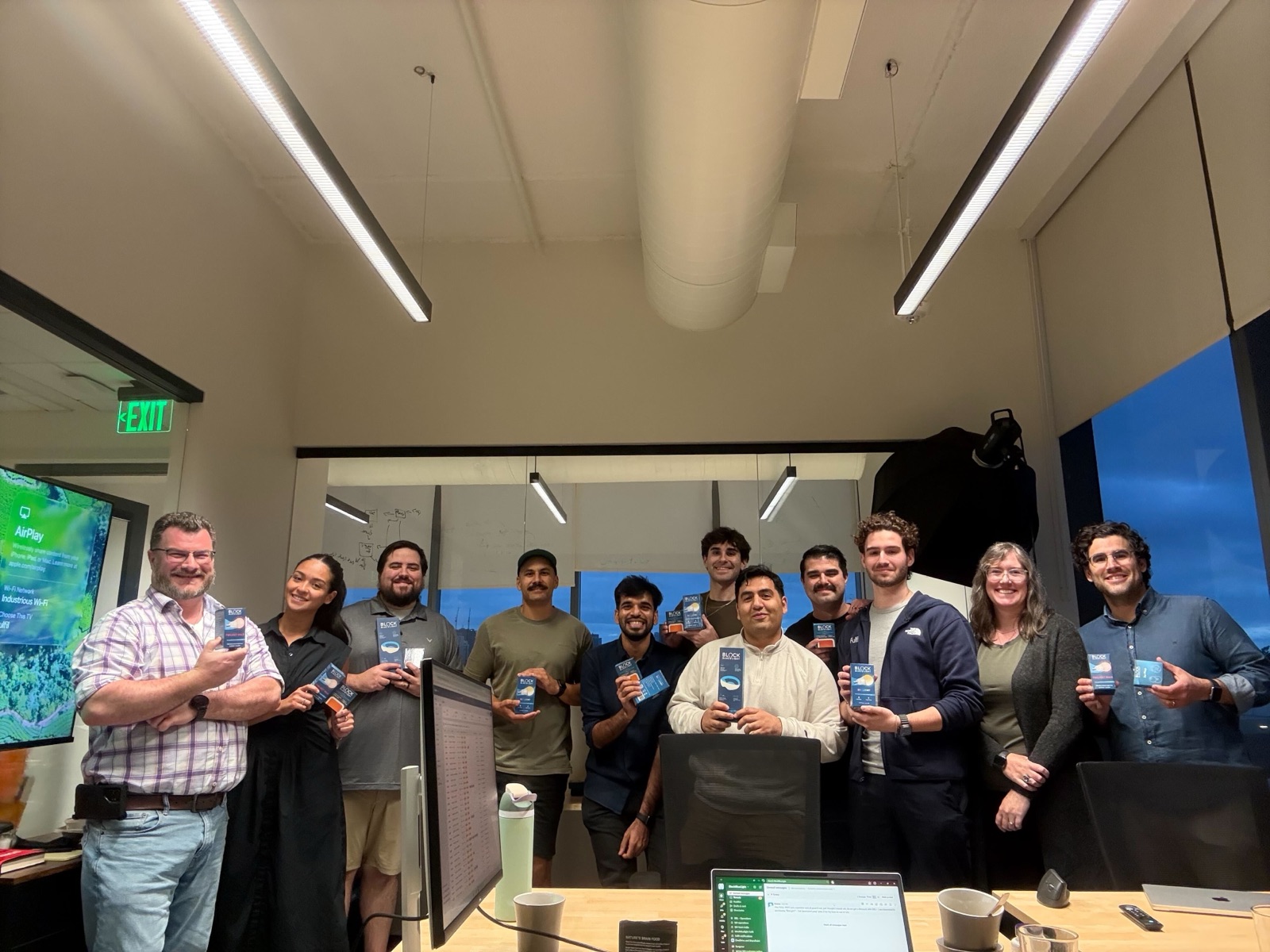

The BlockBlueLight and Fulfil teams during the implementation week in Miami
The team didn't force BlockBlueLight into a fixed way of working, and didn't just agree with everything either.
"It was never, 'No, we can't do it that way, this is how our system works.' It was, 'We understand how your business works, here's how we think about it, so where's the middle ground?' Sometimes it was, 'You should change your process, because the way you're doing it is terrible and this is a much better idea.' There's no black and white 'this is how you must work.' You can build it how you want, and that's been great for operations."
— Arias Giri, Head of Operations
Building Ops Tools With Claude
For Arias, building on Fulfil has been the most fun part. He works through Fulfil's MCP with Claude, and after a call with Fulfil CEO ST, started using the Fulfil CLI for larger data pulls.
"That's probably been the most fun part of the whole journey: building with MCP. I had a meeting with ST a couple of weeks ago, and he pointed me toward the Fulfil CLI for heavy data use. I didn't really know what that was until he jumped on a call and walked me through it. It was really cool that the CEO would get on a call with a client to explain something. I got a lot of value out of it, and I've been learning a lot more about using the CLI for larger data pools."
— Arias Giri, Head of Operations
"You can just talk to Claude, and you don't need to have all the answers. You say, 'This is the problem, this is the kind of solution I want, help me bridge the gap,' and Claude does it for you."
— Arias Giri, Head of Operations
Supply chain tracker. The first tool he built follows every PO from order to landing in a specific regional warehouse, laid out like the Asana boards the team already used.
"Everything's in the Fulfil UI, but it can be hard to find things and learn the search. So I built the tracker the way we like to work. You just say, 'I want a button here, I want to click here and do this, I want a search bar up here.' Now it's something our team is used to, and I could hand it to someone in another department and they'd find their way around and answer their own questions."
— Arias Giri, Head of Operations
Warehouse performance dashboard. It records when each shipment is sent to a 3PL and when tracking comes back, then averages the turnaround into a daily report for each warehouse.
"You can always log into their WMS and see their reporting, but it's nice to have our own data from Fulfil: we sent the shipment at this time, they sent tracking back at this time. The last thing you want at the end of every month is to spend hours digging through data to figure out how a warehouse performed, and what evidence you have to say, 'You slipped a bit this month, we need to step it up or figure out why.'"
— Arias Giri, Head of Operations
Inventory planning tool. His most complex build so far, now in progress.
None of these were one-and-done builds.
"Some of my apps are up to version 30, 40, maybe 50. I'll spend two to three hours on the first build to get it to about 80%. Then I give it to the team and ask what they think. They come back with five or six things, I start working on them with Claude, and along the way it suggests more improvements and finds bugs and errors. We keep iterating until it's really functional and easy for the team to use."
— Arias Giri, Head of Operations
"There are levels to it, from level one or two up to the high end, and it's no problem. Anyone can do it. You just need to know what the problem is and what you need to solve it, then start talking to Claude."
— Arias Giri, Head of Operations
See related: Micro apps and Implementing AI in your operations
Data the Team Can Trust
Before Fulfil, the numbers BlockBlueLight needed either didn't exist or couldn't be relied on.
"Before, we just didn't have the stats or metrics. It was all hidden information. On the supply chain side, the biggest problem before was that we couldn't always trust the data, because there was so much room for human error. Getting to where we can actually analyze our data and make better business decisions has been really key for us."
— Arias Giri, Head of Operations
The Results
Using Fulfil, BlockBlueLight has been able to:
- Route orders from four Shopify stores to five global warehouses with its own rules, including split orders and plug-type regions
- Go live in under three months, as promised during a sales process with hundreds of due diligence questions
- Track accurate landed costs by region, across different freight rates, duties and tariffs
- Replace a spreadsheet ERP with a purchasing process that enforces each step and keeps an audit trail
- Answer supply chain questions in 30 seconds with Fulfil and Claude, instead of half an hour to an hour
- Build its own supply chain tracker, warehouse dashboard and inventory planning tool with Claude on Fulfil's MCP and CLI
- Add new channels faster, with TikTok Shop next and a sixth warehouse in Europe on the way
See related: ERP for beauty and wellness brands
See related: How Atlas Pet Company runs an AI-pilled manufacturing brand with four full-time employees


